

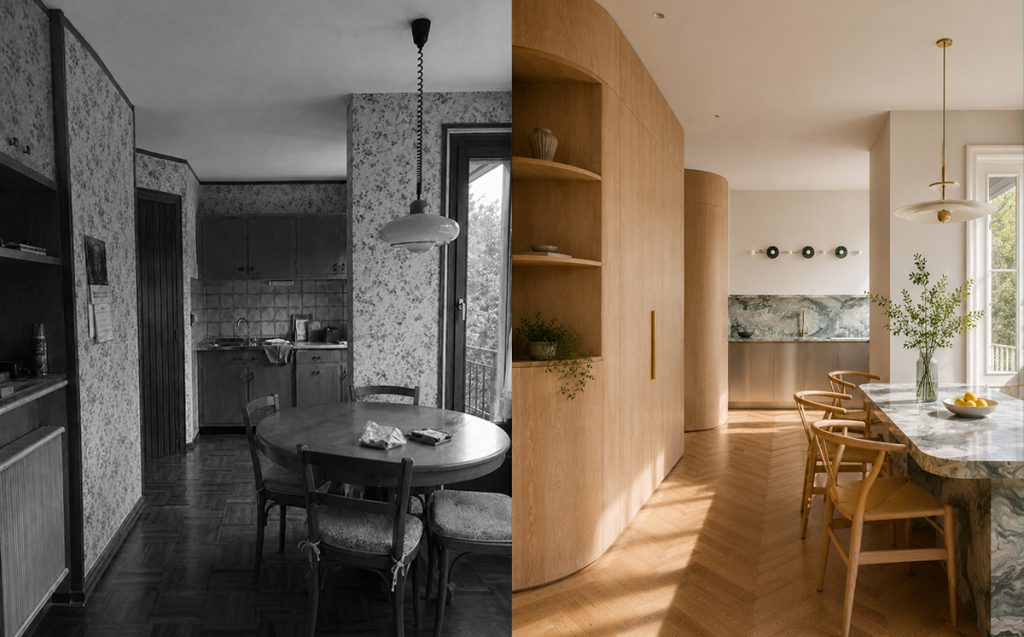
Buying an older apartment to renovate can be a good way to find a well-located property and adapt it to new needs.
The potential of a property, however, does not depend solely on whether the kitchen can be opened up, finishes replaced or bathrooms renovated.
Before purchasing, it is worth understanding what actually belongs to the apartment, what depends on the building, which transformations are possible and which factors may affect the budget.
In Andorra, the mountain climate, heating systems, orientation, the condition of the building envelope and the characteristics of some existing buildings can also have a significant impact on a renovation.
A well-prepared viewing can reveal many of these issues before a decision is made.
1. Look at the building first, not only the apartment
When viewing a property to renovate, it is easy to concentrate solely on the interior.
The building can be just as important.
The condition of the façades, roof, common areas, access, lift, terraces and external elements should be considered.
It is also useful to understand the approximate age of the building and any work carried out during recent years.
An apartment may be in reasonable condition while the building itself is approaching major works.
Renovating the apartment and maintaining the building are two different budgets, and both are worth understanding before purchasing.
2. Ask for information about the owners’ community
Before completing a purchase, it is worth requesting information about the owners’ community.
The most recent minutes of the owners’ meeting are particularly useful.
They can reveal completed works, known problems, outstanding decisions and interventions being considered.
It is also worth asking:
- how much the community charges are;
- what services they include;
- whether extraordinary contributions have been approved or discussed;
- which major works have recently been completed;
- which interventions are being considered;
- how the heating operates where a central system exists;
- which elements are communal and which belong privately to the apartment.
This last point is particularly important.
A window, terrace, façade, roof, duct or installation may be physically connected to the apartment without the owner necessarily being free to modify it.
A change affecting a communal element may require approval from the owners’ community, even if the work itself is carried out from inside the apartment.
These issues can have a significant financial impact and, in some cases, directly affect the renovation project.
3. Understand the heating and energy performance
Heating deserves particular attention in Andorra.
The type of system should be identified, together with whether it is individual or communal, how domestic hot water is produced and how heat is distributed.
For communal systems, it is also useful to understand how consumption is allocated.
Windows, insulation, orientation and exposure to sunlight directly affect comfort and energy use.
Since 2020, information on the property’s energy performance rating has been mandatory for property transfers for consideration in Andorra.
This information is useful, but it does not replace an assessment of the building.
An apartment may have relatively recent windows and still suffer from thermal bridges, cold surfaces or other issues related to the building envelope.
Where possible, actual energy consumption from previous years can provide additional useful information.
4. Look for damp, condensation and water ingress
A mark on a wall should not be treated simply as a paint problem.
It can have very different causes.
Moisture may come from a leak, external water ingress, a terrace, the roof, communal pipework or condensation associated with a thermal bridge.
The appropriate solution changes completely depending on the cause.
Particular attention should be paid to:
- stains and water marks;
- peeling paint;
- mould;
- persistent smells;
- cold areas;
- deteriorated seals around windows;
- walls in contact with the ground;
- junctions with terraces and roofs.
Before hiding a problem behind a lining or new finish, it is important to understand where it comes from.
5. Check whether the proposed layout is actually feasible
An apartment can appear very easy to rearrange on paper and be considerably more constrained in reality.
Structural elements should be identified before imagining large open-plan spaces.
Load-bearing walls, columns, beams and vertical cores can limit certain transformations.
The same applies to building services.
Soil stacks, service shafts, ventilation and ducts are particularly important when relocating kitchens and bathrooms.
Moving a kitchen a few metres may be straightforward in one apartment and technically complex in another.
New bedrooms should also have appropriate daylight, ventilation and dimensions.
The question is therefore not simply “does it fit?”, but “can it work properly?”.
6. Assess the services before deciding what to retain
Keeping old services does not always save money in a renovation.
The electrical distribution board, circuits, plumbing, drainage, hot-water production, heating and ventilation should all be considered.
Future requirements also matter.
A new kitchen, additional lighting, more appliances, air conditioning or home-automation systems may demand different performance from the existing installation.
In some apartments, retaining part of the services makes sense.
In others, a substantial renovation is the right time to replace them and avoid reopening the property a few years later.
The decision should be based on their condition rather than simply on the fact that they currently “work”.
7. Check which approvals the renovation will require
Not every renovation requires the same administrative procedure.
The process depends on the extent of the work and the relevant parish.
Updating finishes raises different questions from altering structure, façades, services, internal layouts or common elements.
The Comuns manage local planning procedures. Andorra la Vella, for example, specifically identifies renovation, repair and rehabilitation within its property and planning procedures.
If the purchase only makes sense because of a specific transformation, its feasibility should preferably be checked before acquiring the property.
It is also important to establish whether proposed work affects communal elements and requires the corresponding approval from the owners’ community.
8. Calculate the whole project, not only the renovation works
Evaluating an apartment to renovate requires looking beyond its purchase price.
The total investment may include:
- acquisition of the property;
- renovation works;
- professional fees;
- administrative procedures and fees;
- kitchen and equipment;
- fitted furniture;
- lighting;
- potential work to building services;
- contingencies.
In our article “How to control a construction budget in Andorra”, we explain why the overall project budget should be distinguished from the amount paid directly to contractors.
This is especially important with an existing property.
A generic cost per square metre can provide an initial indication, but it cannot determine the actual cost of a specific renovation.
Two apartments with the same floor area may require completely different levels of intervention.
9. Separate what is necessary from what genuinely improves the property
Before purchasing, it is also useful to prioritise possible interventions.
They can be divided into three levels.
What is necessary
Addressing defects, inadequate services and elements that have reached the end of their useful life.
What genuinely transforms the apartment
Improving the layout, increasing daylight, creating storage, connecting the kitchen and living space more effectively or making better use of a view.
What is optional
Materials, equipment and elements that can be adjusted according to the available budget.
This hierarchy helps to assess an apartment’s potential more accurately.
A good renovation does not necessarily mean replacing everything. It means understanding what is worth retaining, what needs to be corrected and where an intervention genuinely adds value.
10. Carry out a technical visit before purchasing
A complete design project is not always necessary before buying.
A visit with an architect can help assess several issues in a relatively short time:
- potential for rearranging the layout;
- main technical constraints;
- visible indications of defects;
- apparent condition of the services;
- relationship with communal elements;
- likely level of intervention;
- additional documentation worth requesting;
- initial project priorities.
Such a visit cannot reveal everything hidden behind walls or beneath floor finishes.
It can, however, reduce many uncertainties before committing to a significant investment.
11. Listen to the apartment: acoustics and potential noise issues
The comfort of a home does not depend only on what can be seen.
Before purchasing, it is worth paying attention to noise from neighbouring apartments, common areas and the external environment.
Lifts, staircases, garages, plant rooms, soil stacks and communal services can all generate disturbance.
It is also useful to consider how voices, impact noise and vibration travel between apartments.
Some acoustic issues can be improved during renovation through wall linings, suspended ceilings, floating floors or specific acoustic solutions.
Others are much more difficult to correct because they depend on the building structure, façades or communal elements.
During a viewing, it is therefore worth spending a few minutes listening to the property, rather than only looking at it.
Where the surroundings, traffic or activity within the building raise concerns, visiting the property at another time of day may also be useful.
12. Which documents should be requested before purchasing?
A physical inspection should be complemented by documentation.
Not every document will be available in every case, but before buying it is useful to try to obtain:
- existing plans of the apartment, where available;
- the most recent minutes of the owners’ meeting;
- the amount and scope of the community charges;
- information on extraordinary contributions already approved or being considered;
- details of major works recently completed in the building;
- information on future works being considered by the owners’ community;
- information about the heating and domestic hot-water systems;
- the energy performance rating;
- recent energy bills or consumption data, where available;
- information on previous renovations carried out in the apartment;
- documentation clarifying which elements are private and which are communal.
The aim is not to collect documents without analysing them.
The information they contain should be compared with what was observed during the viewing.
A purchase decision is more robust when the apparent condition of the property, the available documentation and the intended project tell a coherent story.
Buy for the potential, but understand the constraints
An older apartment may provide opportunities that a new property does not: a better location, different proportions, existing elements with character or the ability to create an interior specifically adapted to its occupants.
That potential should be assessed methodically.
Before buying an apartment to renovate in Andorra, it is worth understanding the building, the owners’ community, the layout, the services, the building envelope, the acoustics and the overall budget.
The renovation can then begin from a much clearer starting point.
The aim is not to eliminate every uncertainty before purchasing.
It is to identify the issues capable of significantly changing the project, its cost or the purchase decision itself.
Frequently asked questions
How can I tell whether a wall can be removed?
This should not be determined from its thickness or the sound it makes when tapped. The existing structure should be checked through drawings, inspection and, where necessary, a specific structural assessment.
Can a kitchen or bathroom be moved anywhere in the apartment?
Not always. The position of soil stacks, drainage, ventilation, falls and service shafts can limit or increase the cost of certain relocations.
Is the energy rating enough to know whether an apartment is well insulated?
No. It is a useful indicator, but a visit can also identify orientation, windows, cold surfaces, thermal bridges, condensation and other factors affecting actual comfort.
How much should be allowed for unforeseen work during a renovation?
There is no single percentage appropriate for every project. The allowance should reflect the age of the property, the extent of the renovation and the number of elements that cannot be inspected until finishes are removed or areas opened up.